Sunday, June 17, 2007

The Necessity of Wild Places

Out of all the authors that I read, the one that I keep coming back to is Sigurd Olson. Olson was born in 1899 and raised in northwestern Wisconsin. He was educated at the University of Wisconsin, Madison, and taught biology at Ely Junior College in Ely, Minnesota for the rest of his life. It was his time in Ely (northeastern Minnesota) where he was introduced to the Superior Roadless Area, a massive unspoiled wilderness made up of millions of acres of woods and thousands of lakes. It marked the beginning of the northern frontier--wild country that went all the way to the Arctic Ocean. Today, that plot is now called the Boundary Waters Canoe Area Wilderness--two million acres of woods, lakes, rock, moose, and wolves. It is also the most heavily used wilderness area in the country. It also borders Canada and Ontario's Quetico Provincial Park, another huge wilderness area. Olson (along with the late-congressman Bruce Vento) is largely responsible for the creation of BWCAW.

Sigurd Olson, first and foremost, was a best-selling author of nature writings in the 1950's and 60's. Through his writings he articulated very simply the spirit or the romance that characterizes the North. He often draws on the early French explorers that first came to the area northwest of Lake Superior in the early 1600's, the Indians before them, and the Scottish and British traders that came later. The significance of these people is that the ancient portages they used and the rivers they ran look just as they did hundreds of years ago because of conservation. Most importantly, he was able through his writings to use the imaginations of thousands of people to motivate them to conserve and enjoy wild places. But, things are changing and not for the better.

The Superior National Forest surrounds the BWCAW and the Chippewa National Forest is found in the Central Lakes Region of Minnesota. They are public lands to be used for timber harvest as well as hunting, fishing, camping, etc. But, the current administration along with our shill of a governor are allowing for the auctioning off of these lands for private development. The BWCA may not go away but the roadless areas that bump up against it are disappearing quickly. What is happening to them is that they are being bought by developers, subdivided, and then developed, usually by plunking down a log McMansion. Along with development comes the usual problems--pollution. Since there is no sewer system up north, septic systems are being put in, often times improperly, and then they often leak and contaminate streams, lakes, and ground water with various bacteriae--including every ones' favorite E.Coli.

People also have to have lawns. They put in sod. They have to fertilize. Since the soil is thin and the granite bedrock is very thick, fertilizers find their way into lakes through spates of run-off following rain storms and then dramatically increases a given lake's vegetation growth. When there is too much vegetation in a lake and it dies in the fall it produces a surplus of carbon dioxide which suffocates fish populations and other aquatic fauna.

Then there is the element of sad comedy what arrives with human development.

Have you ever been at a camp ground, and an obnoxious family pulls up at the next campsite in a 150 foot motor home with an external gas generator to run the 56'' HD TV complete with satellite dish outside in front of the family's portable theater seating? It has happened to me. The McMansioning of the North is the next step. Rather than living the sort of life that Thoreau, Muir, Leopold, and Sigurd Olson advocated, people are hauling their shit to the lake.

I like my laptop. I like some stuff. We all do. Bush and the Cons are not totally responsible for the hole the Middle Class is in. There are the instances of credit cards, car loans, and zero-down adjustable rate mortgages. We don't save like we used to. Have have as a nation spent more than we earned last year--for the first time since the early 1930's. We have done our share to create the economy we have. We want cheap crap and we want a lot of it. Look at the clothing you have hanging in your closet. Where is it made? China? Is it something that is going to last for years? Do you need that many shirts? That many pairs of shoes? It used to be that we actually payed for the things we bought. We at least made a sizable down payment on a house and a car. Credit is a good thing when used correctly. It has enable us to own things like houses, but we can't use it they was that we do. We buy. We use. We throw out. We still owe. As Thoreau said, we are leading lives of quiet desperation. Just as we need to be careful with money we need to be careful with our wild places. But, it is our inorganic need to acquire stuff that is damaging the wild places that we so desperately need. We need to understand them. We need to understand ecological balance.

We are not programed to live in cities and suburbs. I know from first hand experience what the sound of water lapping against the side of a canoe, the light of a campfire, the howl of wolves, the sound of wind through a stand of primeval pine trees does for the human condition. It is important to protect these places and it is important to go to these places. We need to educate children about these places.

The saddest thing is we are losing any sense of adventure.

Tuesday, May 29, 2007

A Little Something About Fish

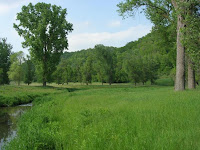
Finally, I got out away from the city and made it into rural Wisconsin for my favorite fish, the brook trout. With a tip from a trout fishing colleague my dad and I headed to a gorgeous little stream about sixty miles west of the Twin Cities. It was one after another all day, both days.

I also saw plenty of deer, wild turkeys, song birds: scarlet tanager, gold finch, indigo bunting, Baltimore oriole, purple martin, red-wing blackbird, and a pileated woodpecker--the goofy one with the big red head. The stream we fished was recently restored. Habitat structures were put into place, the stream channel was narrowed, and as a result trout populations went from 200-300 fish per mile to over 5500.

The stream runs through the unglaciated, driftless area of limestone bluffs which were actually the bed of an ancient sea 350 million years ago. The woods are predominantly hardwood: black oak, silver maple, elm, ash, and the valleys are farmed or in the case of this stream all long-grass prairie. A beautiful place to be.

Wednesday, May 23, 2007

Salvenius Fontinalis

There few fish that are steeped in legend, tradition, and lore. For the fly fishing set, that fish is the Atlantic Salmon. A large, ocean-going salmonid (more closely realated to brown trout than pacific salmon) that enters rugged rivers and is difficult to catch, when hooked runs, jumps, and generally leads to the exhaustion of the angler. There are few places left to catch ocean-run Atlantics in the US. There are many rivers in the remote portions of eastern, maritime Canada, but those rivers don't come cheap. It has been called the fish of kings, Salmo Salar, the name given to it by Julius Caesar and means "The Leaper." Good populations still exist in Ireland, the UK, and northern Europe. But again, they don't come cheap.

In Minnesota the fish that writes the unwritten stories is the muskellunge. A relative of the pike that can grow to enormous sizes, is tough to catch, and is generally an impressive fish to look at.

But, for those of us who are truly crazy, we like to head to the North Woods, to the stinkiest, most mosquito and black fly infested swamp with a tiny and cold creek running through it to catch a fish that seldom grows larger than twelve inches: the brook trout.

For many years I have headed North to streams that don't see people anymore. The sort of streams that run red with tanic acid through shallows, black in the holes, and yellow through the rapids. It's those black, foam-flecked pools, the hiding places, that I look toward. Beneath a good riffle I will swing a black and white wet fly called a Pass Lake with my short, 3weight rod. The little fish show themselves immediately slashing at the fly, missing only to come back and strike it again. The first sign of the fish is the white tips of the fins. Only an oil painter can match the sides of he fish; the red dots haloed with blue rings. The moss back dappled with gold spots and the orange belly--the entire pallette enables the fish to disapear into the stream substrate as soon as the angler releases it.

For me, it always about the rivers, slithering through spruce swamps and muskegs, some nearly covered by the dense tag alder branches or blackened entirely by white and red pine branches. Usually your only company will be a black bear, otter, pine marten, or most often a moose. Ocassionally, there are the wolves, their yellow eyes, and their howl.

What makes these little fish so important is that the places that they live within are the most pristine places we still have. They are a sign of health and wildness, of good country.

Sunday, May 20, 2007

Study to Be Quiet

In the school I work in there is rarely a time when there is silence. My kids, mostly African-American, urban are boisterous, just plain loud. I love their energy, especially when I can focus it. But, some days--fer chriseshakes, shut up!

Fly fishers all over for some reason revere Izaak Walton and his book "The Complete Angler." He didn't fly fish. He dunked worms in the deeper holes of English chalk streams. But, even now, late at night there is no silence here is the big small town of Saint Paul. Sirens keep blurring past. Some drunken ass screams at a street lamp. Neighbors have the strangest sounding sex I have ever heard. I like it better in the winter. The windows stay shut. It stays cool and it is much easier to sleep.

My people came almost entirely from Norway and Sweden. Some also came from Ireland--which I like to believe explains my drunkenness. The point is I don't deal well with Minnesota's new climate. As a Scandihoovian I also don't deal well with loud, talkative people. I am not uncomfortable with long spells of silence. My few friends are those that can sit with me while we enjoy each others company and not have the nagging need to converse. It is Ike Walton who said my favorite phrase, "Study to Be Quiet." Thoreau and Sigurd Olson also favored that phrase and was prominent thematically throughout their writings which I love so much.

Wednesdays are quiet reading days in my classroom. Friday nights are quiet fishing times in my life. I am eagerly awaiting the time when I can get North to a place so quiet I can hear my own heart beat. Until then in my classroom we will study.

Sunday, May 13, 2007

A Little Something About Fish

I went fishing in southeast Minnesota, near Rochester with my dad yesterday. We had not been in that area for about five years. It's an area that has enormous potential for trout fishing, but due to some poor farming practices and development is still suffering from habitat degradation.

The biggest issue that Trout Run has is cows are allowed to trample the banks, destablizing the soil and causing erosion which ends up in the deeper, slower holes, eliminating habitat, and also reducing the gradient. When the stream slows down the riffles, rapids which provide spawing areas for fish are also burried by the silt. Riffles also oxygenate the water, keep it cool, and provide rocky homes for a variety of aquatic insects.


The stream was absolutely clear. I could see the fish in the slower areas gliding over the bottom catching whatever insects were swept away in the current. All fish are non-native brown trout. We caught several nice fish, averaging 12 inches. Which is better than it was years ago. The stream now has a slot limit protecting fish: all fish between 12 and 16 inched must be returned to the stream. Five fish limit with only one being larger than 16 inches. The idea for the slot is to protect the spawining population. Wild trout are better for many reasons. The first being that they are shy and will flee from predators and they are harder to catch. The second is that they are self-sustaining, and stocking is not needed--which is expensive.

Trout Run is being repaired, slowly. Habitat improvements such as artificial hiding "cribs" or undercut banks are being added to stablize the banks and provide places for fish to live. Hewlit ramps which are artificial rapids oxegenate the water and stir up the silt washing it out of critical areas of stream. It is working.

So why should anyone care? Because healthy streams mean healthy, self-sustaining fish populations. Also, if banks are stabilized valuable top soil stay on the farm fields which lead to higher yields for farmers, more money. Also, banks are stabilized artificially and then native prairie grasses are added which provide habitat for gamebirds and other wildlife. It's about ecological balance. Grasses also filter out any fertilizers and pesticides, or keep it on the fields where it belongs. It's also about economic balance. Good trout fishing is big business. Those who trout fish spend money on gear, beer, B&B's, food, guides--all of which is good for rural communities. This is not about being a whacked out tree hugger its about good envronmental stewardship and business practices.

(Pleas note my pirated images of an improved stretch of Trout Run and a nice brown trout)